
Topic: Uncategorized
-
The Subjunctive in English?!?!
Hola! Have I ever told you how much I love The Economist? I love The Economist so much! When I first saw it on the newsstand, I figured it was a boring magazine about economics. But, it’s way more than that! It talks about current affairs, international business, politics, technology, and culture. It’s a great way to keep up with what’s going on in the world (not just the one or two storylines most news sources focus on). The Economist has helped me start so many great conversations as I’ve traveled through Spanish-speaking countries. So, even though it’s in ENGLISH, The Economist has helped me tons with my SPANISH! I’ll tell you more about The Economist in the future. Right now, I want to talk about a specific article I just came across. Every two weeks in the Culture section, they have an article called Johnson, which talks about something language-related (so, Johnson is my favorite article in my favorite magazine). And, recently… Johnson talked about “the subjunctive”… in ENGLISH! https://www.economist.com/culture/2022/06/16/far-be-it-from-the-english-to-use-the-subjunctive (if you register, you can read the article for free). Have you heard of the subjunctive? If not, just know, it’s the bane of every Spanish student’s existence (if you continue with Spanish, you’ll inevitably run into the subjunctive). Regardless, did you know we have the subjunctive in ENGLISH too?!?! For the longest time, I didn’t! But, we do! We have the subjunctive in English! When we say, “God SAVE the queen” or “God BLESS America” – that’s the present subjunctive (instead of “God SAVES the queen” or “God BLESSES America”). Those phrases might look like the imperative (commands) but they’re not. As The Economist points out, “the faithful do not order the creator of the universe around”. “God save the queen” is basically saying, “MAY God save the queen” (it’s a desire, not a command) And, “God bless America” is basically saying, “MAY God bless America” (desire, not command). When we say, “If I were you…” instead of “If I was you…” – that’s the past subjunctive! I’m not going to get into all the technical grammatical mumbo jumbo here. The main point now is… we have the subjunctive in English too (though, it’s not nearly as common as it is in Spanish). Nothing earth-shattering here, just something I found interesting–and thought you might too. Hasta luego, Jordan P.S. Keep an eye out for a video dedicated to the subjunctive [in Spanish] before the end of the year.
-
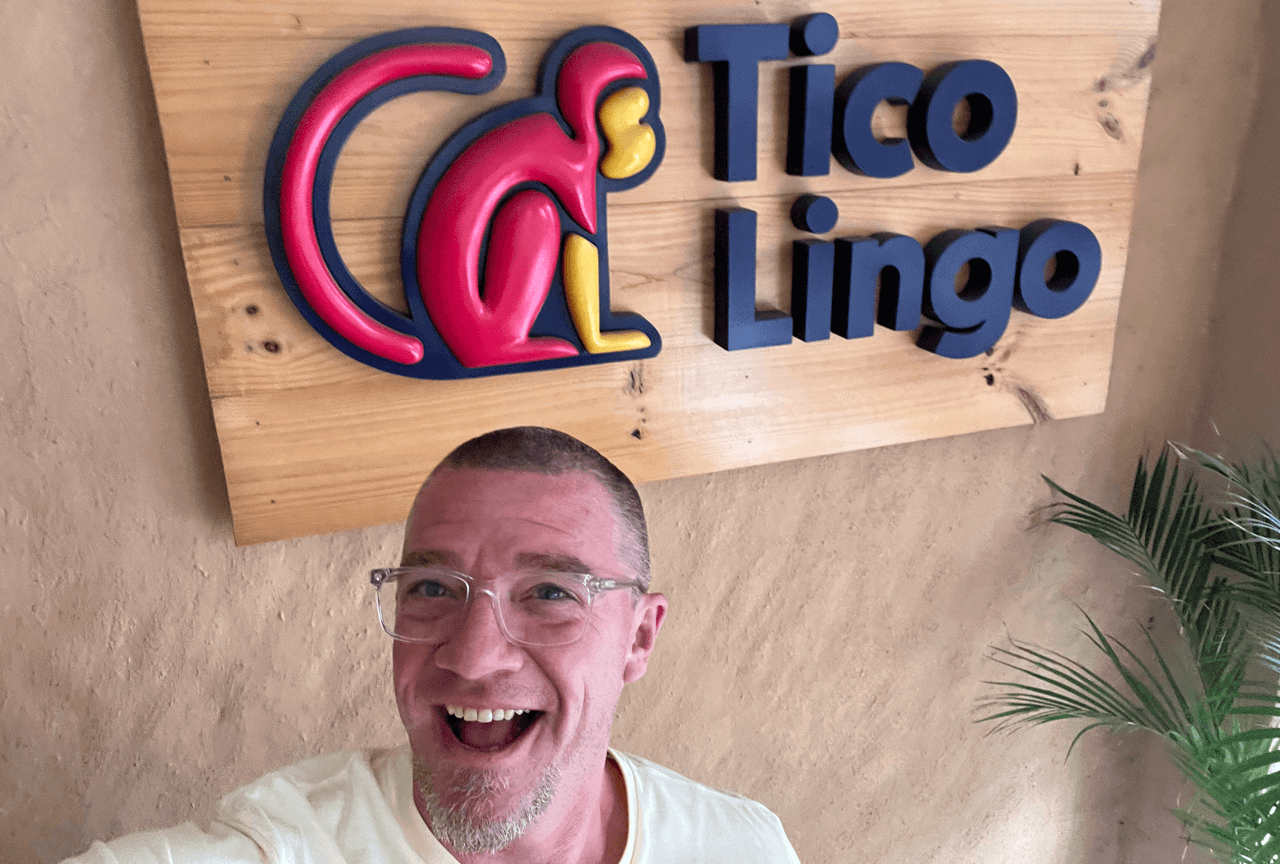
Studying at Tico Lingo in Heredia, Costa Rica
Hola! I’m excited for my third day of Spanish classes here at Tico Lingo in Costa Rica! You might think of me as a Spanish TEACHER, but I’m also still a Spanish LEARNER [for life]. The truth is, my Spanish isn’t nearly as good as I want it to be. When I made my first Spanish video almost TEN years ago (what???) – improving my Spanish was still a big goal. But, my videos, my business and life got in the way. Sure, I’ve learned lots from making my videos… And, on my own, I’ve studied tons of grammar and had iTalki partners… But, we can only progress so much by studying grammar and speaking Spanish for an hour a week. You’ve probably heard me say this before: the #1 best and fastest way to improve your Spanish is TOTAL IMMERSION. And the easiest way to totally immerse yourself is to attend a Spanish immersion school and live with a Spanish-speaking family. So, that’s what I’m doing! I chose Tico Lingo because it’s a smallish, family-style school (I’m not into big companies or institutions). Plus, it’s located in a town that has almost ZERO tourists. Which means, I’m experiencing the real Costa Rica–not influenced by gringos or tourism. More importantly, it means, when I order lunch at the market, nobody responds to me in English (because they don’t speak it). So, I’m speaking Spanish at breakfast with my Costa Rican family… I’m speaking Spanish in the streets, at the market and in restaurants… I’m speaking Spanish in class, four hours a day… I’m speaking Spanish when I get a haircut… I’m speaking Spanish when I eat dinner with my Costa Rican family… TOTAL IMMERSION. The #1 best and fastest way to improve your Spanish. Tomorrow, I’ll post about how these Spanish immersion schools work (they’re all over the Spanish-speaking world). So, if you have any questions, ask away at support@wordpress-828256-4067193.cloudwaysapps.com. Until then, PURA VIDA (something they say all the time in Costa Rica). Jordan
-
Spanish Immersion Schools: How They Work
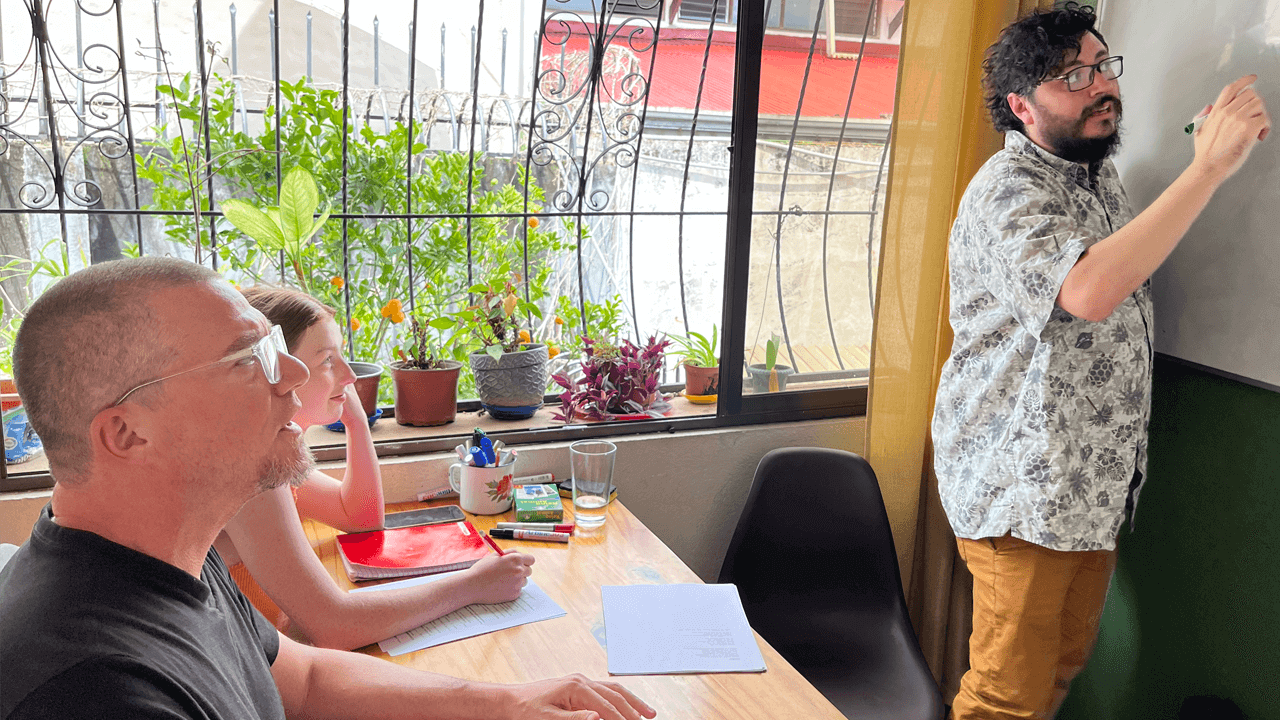
Hola! If you missed yesterday’s post, I’m at a Spanish immersion school in Costa Rica: Studying at Tico Lingo in Heredia, Costa Rica Today, I’m going to tell you how these schools work. –They’re all over Latin America & Spain–in big cities, medium cities and small cities. –After you enroll, they give you a written and oral test, in order to place you in a group at your level (1-6 people). –You can also take private, 1-on-1 lessons or a mix of private and group lessons (I prefer the group lessons because I learn so much from the other students, and the conversation is usually better). –All levels are welcome–from total beginners (zero Spanish) to advanced students. –Some schools have specific programs for young people and some schools have summer camps for young people (2-4 weeks). –At most schools, you can start on any Monday (though, some schools only let beginners start on specific weeks). –You can attend for one week or a zillion weeks, it’s up to you. –Classes usually run from 8am to 12pm, M-F. Though, sometimes they go from 1pm to 5pm. –Classes are a combination of grammar and conversation (I think it’s fun to have conversations about grammar–killing two birds w/ one stone). –There are usually activities available after class (cooking, dancing, yoga). –Some schools set up language exchanges (intercambios) with people from the local community that want to practice their English (they practice English, we practice Spanish). –Almost all schools offer the option of a homestay where you live and eat with a local family. Other schools offer rooms in apartments with Spanish speakers. You can also stay in your own accommodation. –I’ve done all types of accommodations but the best for learning Spanish are living in a family’s home or sharing an apartment with a Spanish speaker. –Prices vary, but generally, four weeks of class is usually around US$1,000 and four weeks of accommodation is usually around US$1,000 (which includes breakfast and dinner, sometimes laundry and other stuff). –I’ve studied at five schools so far (three in Spain, one in Argentina, and one in Costa Rica). Some are better than others, but all have been wonderful experiences. –Bottom line: I don’t know any easier way to fully immerse yourself in a Spanish-speaking world. If you want to improve your Spanish, I highly suggest attending a Spanish immersion school–or multiple. If you have any questions, send me an email at support@spanishdude.com Hasta luego, Jordan